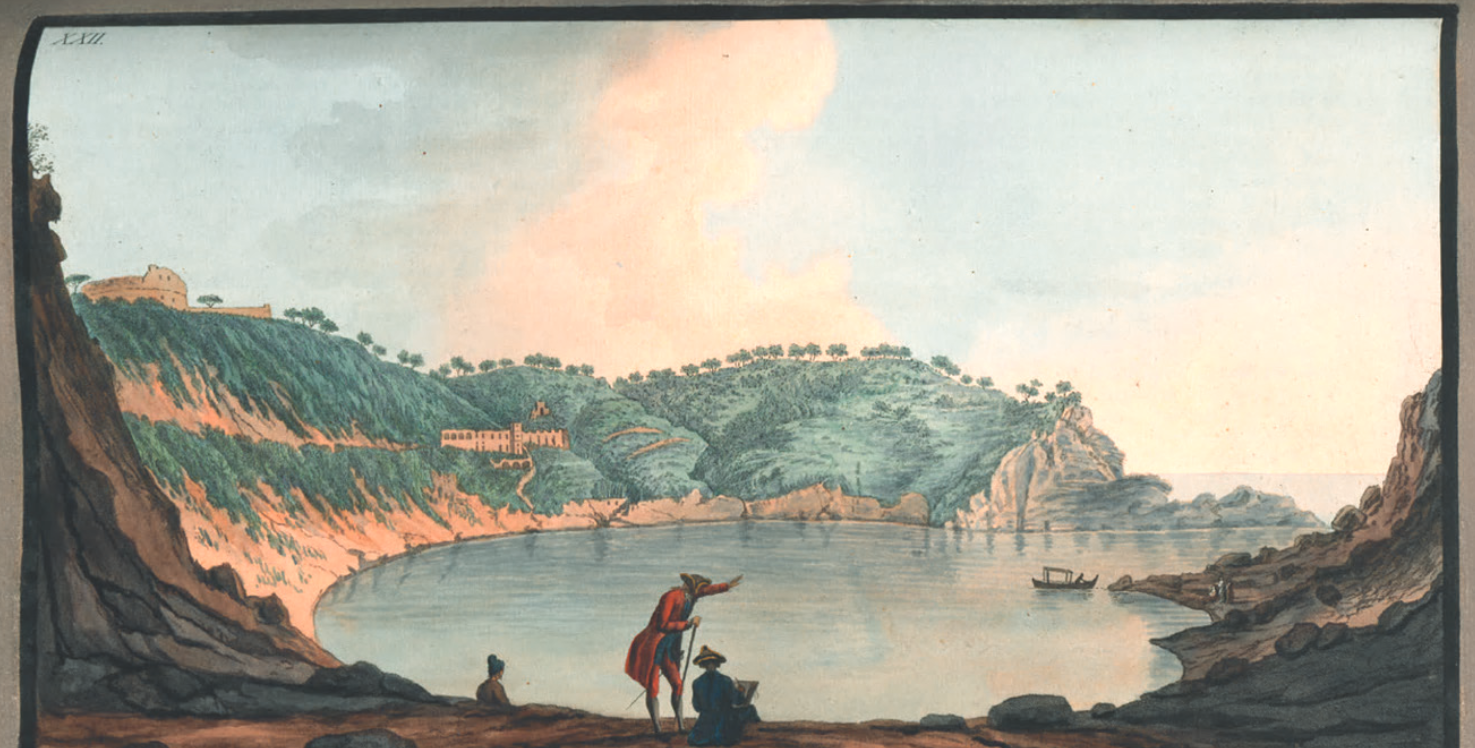
Mostly, however, the observer and his draftsman are not alone in the landscape. Often we see other people, other groups of hikers or travelers who have nothing to do with them. Someone is always already there. Nowhere is one the first here. Nature is never truly wild and remote from humans. There is a lot of civilization in Fabris’s drawings: ships, cities, buildings, roads, farm animals and fields.
Prince Franz von Anhalt-Dessau was so enthusiastic after his visit to Hamilton in Naples that he had a replica of the latter’s villa and a miniature of Vesuvius built in his park at Wörlitz in east Germany. It was even artificially erupted from time to time. Hamilton himself, when he returned to England from his diplomatic post, passed through the area with his wife and with Nelson. Already during his lifetime he had inspired an experiential staging of volcanic nature.