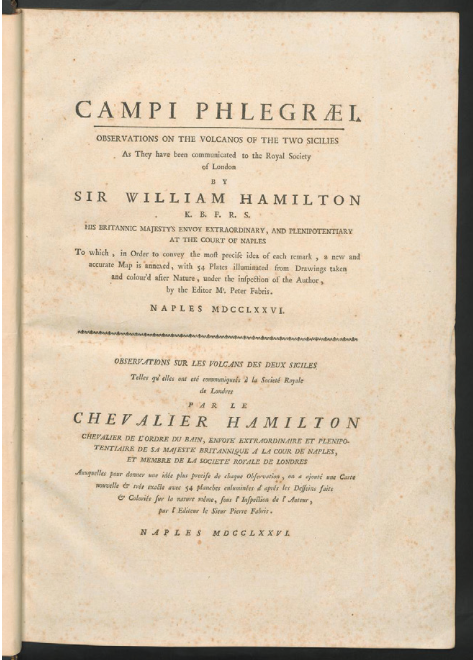
To convey his experiences on the ground – in sulfur-smelling craters and on glowing lava, but also in lush vineyards and on picturesque Mediterranean bays – to a wide audience, Hamilton employs not only texts but also pictures. In addition to his nature reports, his book consists of an “accurate Map” and, above all, of colored “plates” that illustrate his descriptions. Based on “precise” sketches from the field, they are “illuminated from Drawings taken and coulour’d after Nature,” as the title page suggests.
These illustrations largely contribute to the appeal of the book. And they point to another important aspect of the title page: authorship, or co-authorship. While Hamilton is the “Author” of the texts, the illustrations were made by the English-Italian artist Pietro Fabris, who is also named as the “Editor” of the work. Th e book was thus produced not only in connection with a scientific community in London, but also with interdisciplinary cooperation on site in Naples.